
Burst Pipe Emergency: What to Do in the First Hour
Written & reviewed by the Pro Max Restoration Technical Team
IICRC-Certified Restoration Technicians
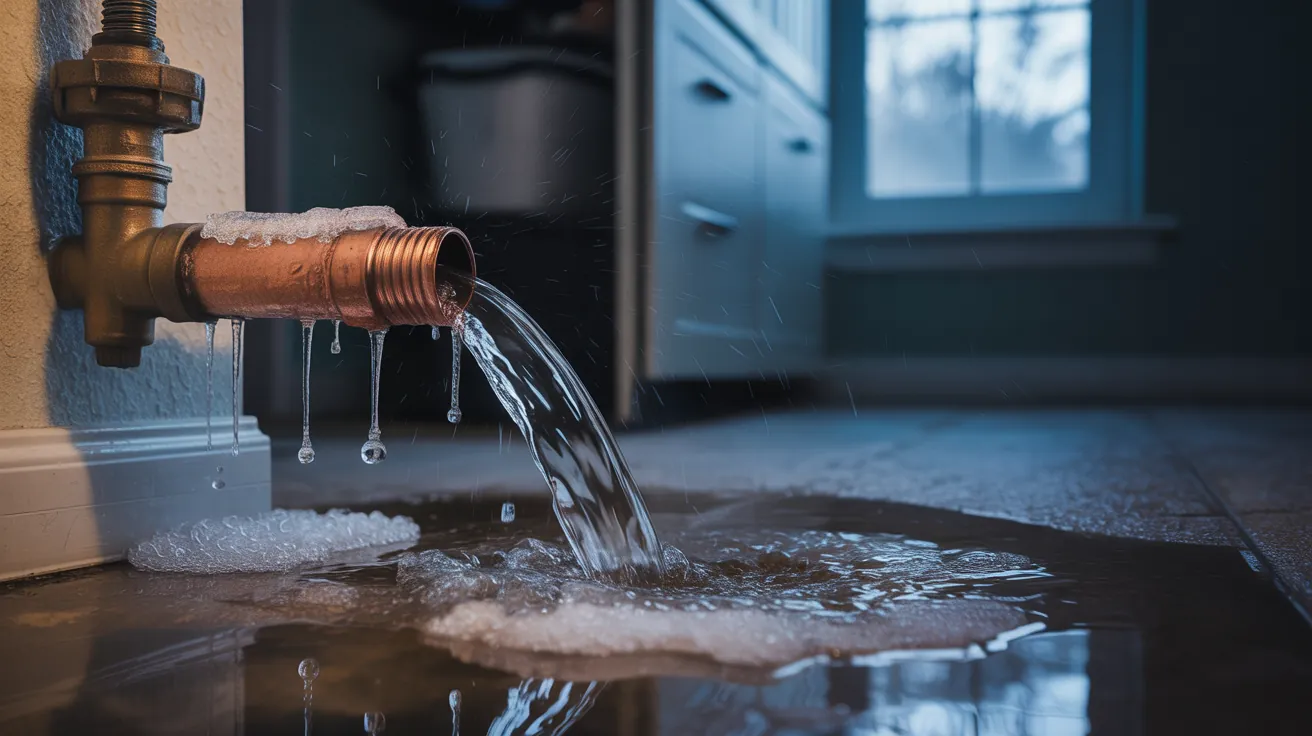
A burst pipe can release hundreds of litres before anyone notices. This step-by-step guide covers what to do in the first sixty minutes, where to find your shut-off valve in a Toronto home, what never to do, and what professional restoration involves afterwards.
A burst supply line does not trickle. A half-inch pipe under normal municipal pressure can release several hundred litres an hour, and it does not stop until someone turns it off. In a Toronto home that means the first sixty minutes largely decide whether you are looking at a contained loss or a gutted basement. Here is exactly what to do, in order.
The first hour, step by step
1. Shut off the main water valve (first 60 seconds)
Everything else is secondary. In most Toronto houses the main shut-off is in the basement on the wall facing the street, usually near the water meter, and it is either a lever-style ball valve or a round wheel-style gate valve. In a condominium or apartment, look for in-suite isolation valves under sinks, behind the toilet and at the water heater; if you cannot stop it there, call the concierge or property manager immediately, because the building shut-off is theirs to operate. If the valve is stiff, do not force it to the point of snapping the stem — older gate valves seize, and a broken valve makes the situation considerably worse.
2. Cut power to wet areas
If water is near outlets, baseboard heaters, light fixtures or any electrical equipment, switch off those circuits at the panel. Do not stand in standing water to reach a panel, and do not touch a panel that is itself wet. If the panel is inaccessible or water has reached it, stay out of the area and call an electrician or Toronto Hydro.
3. Drain the system
Open the lowest cold taps in the house and flush a toilet or two. This relieves residual pressure and empties the remaining water in the pipes into a drain rather than into your ceiling. If the burst was on the hot side, turn off the water heater as well — gas to pilot or off, or the breaker for an electric unit — so it is not firing with no water in it.
4. Document before you move anything
Photograph and video every affected room, including standing water, wet ceilings and walls, affected contents, and the failed pipe itself if it is visible. Do this before you move furniture, pull carpet or start mopping. This is the single most valuable five minutes of an insurance claim, and once you have started cleaning up, it cannot be recreated.
5. Call a restoration company, then your insurer
Call a 24/7 restoration contractor first so extraction is on its way, then notify your insurer. Most Ontario policies require prompt notice and require you to take reasonable steps to prevent further damage, so starting mitigation immediately is a policy obligation rather than a decision that has to wait for an adjuster's approval. Pro Max Restoration answers at any hour on 416-988-3539 and averages about 45 minutes across the GTA.
6. Start removing water only where it is safe
While you wait, move contents out of the wet area, lift furniture legs onto foil or blocks so stain does not transfer to wet flooring, and mop or wet-vac standing clean water if you can do so safely. Do not attempt this if the water may be contaminated, if it is near electrical equipment, or if a ceiling is bulging.
What never to do
- Do not stand under a sagging ceiling. A drywall ceiling holding water can release tens of kilograms without warning. Clear the room and, from a safe position at the edge, relieve the bulge with a small puncture and a bucket underneath if you are confident doing so.
- Do not use a household vacuum. Only a wet-rated extractor is safe for water; a standard vacuum is an electrocution risk.
- Do not assume it will dry on its own. Surfaces dry long before wall cavities, subfloors and insulation do. Trapped moisture is the leading cause of the secondary mold claims we are called back to fix.
- Do not throw damaged items out before they are documented. Photograph and list them first, and keep them if practical until the adjuster has seen the file.
- Do not turn the water back on to test the repair until a plumber has isolated or replaced the failed section.
Why pipes burst in Toronto homes
Freezing is the most publicised cause and a genuine one here. Water expands as it freezes, pressure builds between the ice plug and a closed tap, and the pipe splits — usually somewhere unheated, such as an exterior wall, a crawlspace, a garage, an unheated basement corner, or at a hose bib that was never drained in the fall. The burst frequently is not discovered until the thaw, when water starts moving through the split. Our guide to preventing frozen and burst pipes in a Toronto winter covers the preventive side in detail.
Corrosion and age account for most of the bursts we attend outside deep winter. Copper develops pinhole leaks on horizontal runs and at elbows. Galvanized steel in pre-1960s homes scales shut internally and fails at threaded joints. Older polybutylene and early plastic fittings become brittle. In much of Toronto's original housing stock these systems are now well past any reasonable service life.
Water pressure that is too high stresses every joint in the system. Above roughly 80 psi, fixtures, hoses and connections fail earlier than they should, and a pressure-reducing valve is an inexpensive fix. Water hammer — the bang you hear when a washing machine or dishwasher valve closes quickly — adds repeated shock loading to the same joints.
Mechanical damage is the quiet one: a nail or screw driven into a pipe during a renovation may take years to corrode through and then fail inside a finished wall with no warning at all.
What professional restoration involves
Once the water is off, the job is to find all of it, remove it and dry the structure to a verified standard. Our technicians start with FLIR thermal imaging and calibrated moisture meters to map the actual wet footprint, which after a burst pipe is almost always larger than the visible damage, because water tracks along framing, down inside wall cavities and under flooring. That moisture map determines exactly what gets opened, so demolition is targeted rather than exploratory.
Truck-mounted extraction removes standing water quickly, and weighted extraction tools pull water up through carpet and underlay rather than skimming the surface. Structural drying follows: high-velocity air movers creating controlled airflow across wet surfaces, LGR dehumidifiers pulling that moisture back out of the air, and HEPA air scrubbers managing particulates. Equipment placement is recalculated daily as readings change, and it stays until every calibrated reading meets the IICRC S-500 dry standard for that material rather than until a set number of days has passed. Most residential dries run three to five days. You receive the daily log, which also forms the backbone of your insurance file. If mold has already begun, remediation follows IICRC S-520 with containment, negative air pressure and HEPA filtration. See our burst pipe repair and water damage restoration services for the full process.
Cost and insurance
Burst pipe damage across multiple rooms in Toronto typically runs $2,500 to $7,500 in 2026, with contained single-room losses often under $2,500 and multi-storey losses considerably more. Our Toronto water damage cost guide breaks the numbers down by scenario.
On insurance, a burst pipe is one of the most reliably covered causes of water damage in Ontario, because it is sudden and accidental — exactly what a standard policy is designed for. Your out-of-pocket cost is normally your deductible. Two caveats are worth knowing. First, a burst caused by freezing may be questioned if the home was left unheated and unattended, and many policies contain specific wording about vacancy, heat maintenance and shutting off the water. Second, a gradual leak from the same pipe that was ignored is treated very differently from a sudden failure. Pro Max Restoration documents the loss and the cause carefully for exactly this reason, and bills all major Canadian insurers directly.
Before the next winter
- Locate and label your main shut-off, and confirm it actually turns. Replace a seized gate valve with a quarter-turn ball valve.
- Disconnect and drain garden hoses and shut off the interior valve feeding each outdoor hose bib in the fall.
- Insulate pipes running through unheated spaces, and let a cold tap trickle on extreme-cold nights on runs you know are vulnerable.
- Replace braided washing machine and dishwasher hoses every five to seven years.
- Keep the house at a minimum temperature when travelling, and have someone check it, or shut off and drain the water entirely.
Dealing with a burst pipe right now? Call 416-988-3539 any hour of the day. We respond across the GTA with an average arrival of about 45 minutes, including North York, Scarborough, Etobicoke and the surrounding regions, or request a free assessment online.
Frequently Asked Questions
What is the very first thing to do when a pipe bursts?
Should I turn off the electricity after a pipe bursts?
Does home insurance cover a burst pipe in Ontario?
How much does burst pipe water damage cost to repair in Toronto?
Can I just let it dry on its own?
Why do pipes burst in Toronto homes?
Need Professional Restoration Help?
Our IICRC-certified team is available 24/7 for emergencies and free consultations.
Call 416-988-3539