
Fire Damage Restoration Cost in Toronto (2026)
Written & reviewed by the Pro Max Restoration Technical Team
IICRC-Certified Restoration Technicians
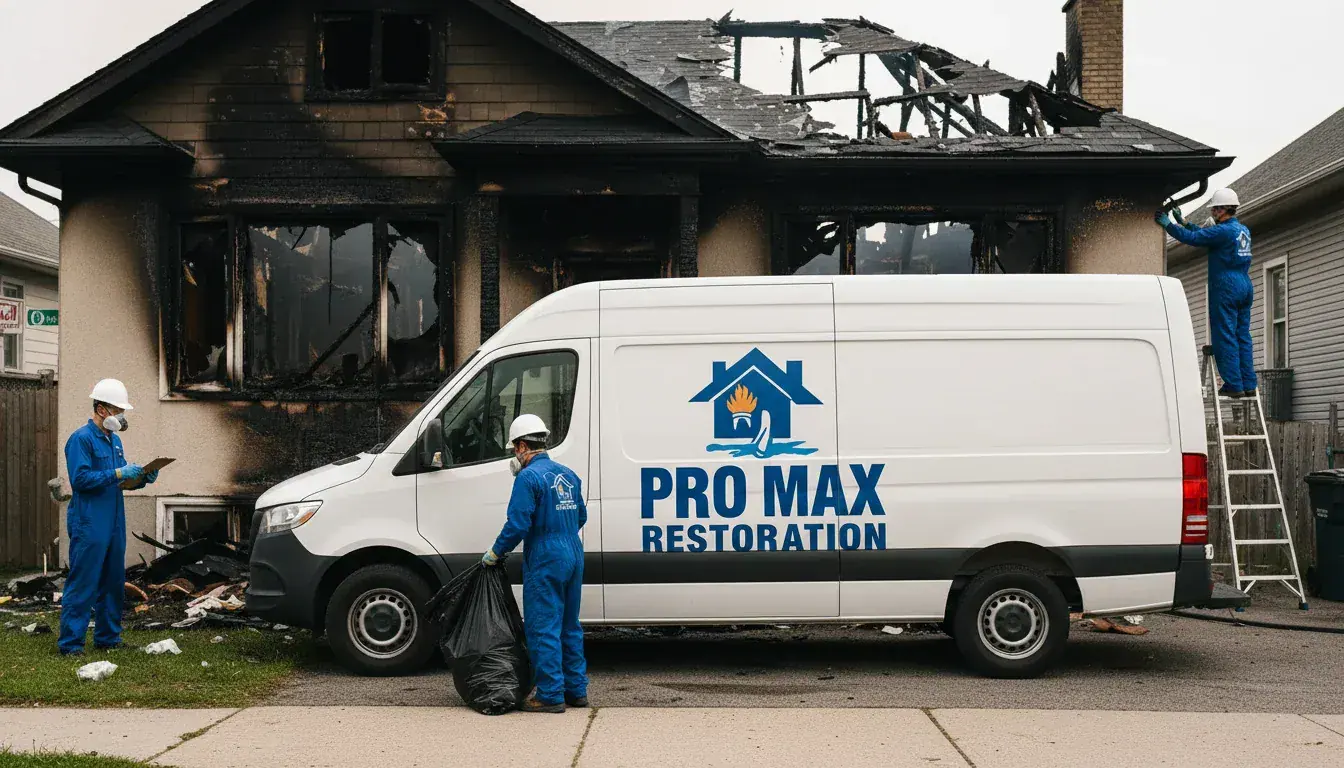
How much does fire damage restoration cost in Toronto in 2026? A clear breakdown of emergency board-up, smoke and soot cleaning, odour treatment, contents pack-out and full rebuild pricing, what drives each number, and how insurance applies.
After a fire, the two questions every homeowner asks are how much of the house can be saved and what it is going to cost. The honest answer to the second is that fire restoration pricing spans a very wide range, because a kitchen fire that filled a house with smoke and a structural fire that took the roof off are not the same job. Below is a straight 2026 breakdown of what fire damage restoration actually costs in Toronto and the GTA, and what drives each number.
Average fire damage restoration cost in Toronto (2026)
For a typical Toronto home, professional fire damage restoration runs $3,000 to $25,000. Smoke and odour losses with no structural damage frequently land between $1,500 and $6,000. At the other end, fires that destroy framing, roofing, mechanical systems and finishes across multiple rooms routinely reach $50,000 to $150,000 or more once full reconstruction is included. The single biggest variables are how far the smoke travelled, how much building material has to be removed rather than cleaned, and whether the job ends at cleaning or continues into a rebuild.
Fire restoration cost by scenario
| Scenario | Typical Toronto cost (2026) |
|---|---|
| Emergency board-up, tarping and securing (standalone) | $500 – $2,500 |
| Smoke and odour only, one or two rooms, no structural damage | $1,500 – $4,500 |
| Contained kitchen fire with whole-home smoke migration | $5,000 – $15,000 |
| Single-room fire with structural damage and rebuild | $15,000 – $40,000 |
| Multi-room or multi-storey fire with full reconstruction | $50,000 – $150,000+ |
| Add-on: firefighting water extraction and structural drying | $1,500 – $6,000 |
| Add-on: contents pack-out, cleaning and storage | $2,000 – $10,000 |
| Add-on: HVAC duct cleaning and decontamination | $600 – $2,500 |
| Add-on: thermal fogging / hydroxyl / ozone odour treatment | $800 – $4,000 |
These are planning estimates for the Toronto market, not quotes. Fire losses vary enormously and the only accurate number comes from an on-site assessment. Request a free assessment and we will provide a written, itemised scope before any work begins.
What actually drives the price
1. The type of fire, and therefore the type of soot
This is the cost driver homeowners never anticipate, and it matters more than square footage on smaller losses. Soot is not one substance. A protein fire from cooking leaves an almost invisible, greasy film with an intense odour that bonds to every surface in the house, including inside cabinets and drawers. It is one of the most labour-intensive residues to remove precisely because there is so little to see and so much to clean. A synthetic fire involving furniture, electronics, carpet and plastics leaves heavy, dry, black soot that must be dry-sponged before any moisture touches it, because wet-cleaning first smears it permanently into porous surfaces. A natural-material fire burning wood and paper leaves a lighter, powdery residue that is easier to remove but travels the furthest through a building. Misidentifying the residue type at the start is the most common way a fire restoration job goes over budget, because surfaces that could have been cleaned end up needing replacement.
2. How far the smoke travelled
Fire damage is usually contained. Smoke damage rarely is. Smoke follows air movement, which means it moves through hallways, up stairwells, into the HVAC return, through the duct system and out into rooms on the far side of the house. In an apartment or condominium it travels through corridors, garbage chutes, elevator shafts and shared ventilation into units several floors away. A fire that burned in one room can easily produce a cleaning scope covering the entire dwelling, and the ductwork almost always has to be cleaned and decontaminated as part of it.
3. How much material is removed versus cleaned
Cleaning is cheaper than demolition and rebuild by a wide margin, so the ratio between the two largely sets the final number. Non-porous surfaces such as tile, metal, glass and sealed hard surfaces clean well. Semi-porous surfaces such as hardwood, unfinished wood and grout are borderline and depend on exposure time. Porous materials, including insulation, carpet underlay, upholstered furniture, mattresses and often drywall, absorb odour compounds so thoroughly that removal is the only reliable outcome. A fast professional response shifts material out of the replace column and into the clean column, which is why emergency response speed is a cost issue and not only a comfort issue.
4. Firefighting water
Suppressing a house fire puts a very large volume of water into the structure in a short time, and it runs downward through floor assemblies into rooms that never saw flame. That water has to be extracted and the structure dried to the IICRC S-500 standard, or the fire loss becomes a mold remediation job within days. Water extraction and structural drying are a normal line item on fire estimates, typically $1,500 to $6,000, and skipping them to save money reliably costs more later. Our approach to this stage is the same as on any water damage restoration project, with daily logged moisture readings until materials meet their dry standard.
5. Contents
Contents are priced separately from the structure and are frequently the most under-documented part of a fire claim. Where on-site cleaning is impractical, belongings are packed out to a controlled facility, inventoried, and cleaned using methods matched to each category. Ultrasonic cleaning recovers far more hard-surface contents than most homeowners expect. Textiles, electronics, documents and photographs each require different handling. Pack-out, cleaning and storage typically adds $2,000 to $10,000 depending on volume and duration, and a thorough inventory is what ensures the contents portion of your claim reflects what you actually owned.
6. Odour treatment
Deodorisation is a distinct stage with its own cost, and it only works when it is sequenced correctly. Fogging a house that still contains soot-laden insulation or a contaminated duct system achieves nothing, because the source keeps re-releasing odour compounds. Once unsalvageable porous materials are gone and everything restorable is cleaned, thermal fogging, hydroxyl generators or ozone treatment neutralise the remaining compounds. Expect $800 to $4,000 depending on the size of the structure and the severity of the odour.
Does insurance cover fire damage in Ontario?
Yes, in almost all cases. Fire is a standard covered peril on virtually every Ontario home, condominium and tenant policy, and the smoke and water damage caused by the fire are generally covered alongside it. In practice your out-of-pocket cost on a covered fire loss is usually limited to your deductible, typically $500 to $2,500. Two coverages matter a great deal after a fire and are often forgotten:
- Additional living expenses — covers hotel, temporary rental and reasonable extra costs while the home is unlivable. Keep every receipt from day one.
- Contents coverage — may be actual cash value or replacement cost depending on your policy wording, and the difference on a fire claim can be substantial.
Pro Max Restoration bills all major Canadian insurers directly, including Intact, Aviva, Desjardins, TD Insurance, Wawanesa and Co-operators, and documents the loss with photographs, inventories and moisture readings to the standard adjusters expect. That means you are not funding a five-figure restoration while a claim is processed. If you are weighing whether to claim at all on a smaller smoke loss, the same logic applies as with water damage, which we cover in our guide to filing a claim versus paying out of pocket in Ontario.
How to keep fire restoration costs down
- Get the property secured immediately. A house left open after a fire keeps taking damage from rain, wind, frost and theft, and none of that was part of the original loss. Board-up and tarping is the cheapest money you will spend.
- Do not clean soot yourself. Wiping dry synthetic soot with a damp cloth drives it into drywall, grout and upholstery permanently, converting cleanable surfaces into replacement items. This is the single most expensive well-intentioned mistake homeowners make.
- Do not run the HVAC system. Turning on the furnace or air conditioning after a fire distributes soot through every duct and into rooms that were unaffected.
- Document everything before anything moves. Photograph and video every room, including inside closets and cabinets, before restoration begins. It protects both the structure and the contents portions of your claim.
- Use one contractor end to end. Splitting board-up, cleaning, drying and rebuild across separate companies adds coordination cost, extends the timeline and creates gaps in warranty and responsibility.
Why single-source restoration matters after a fire
A fire loss is really four projects stacked on top of each other: emergency securing, water damage restoration, smoke and soot cleaning with odour treatment, and structural reconstruction. When those are contracted separately, homeowners end up acting as project managers from a hotel room, and disputes over who was responsible for what surface at what stage are common. Pro Max Restoration carries the whole sequence under one contract, with one estimator producing the insurance documentation and one schedule running from the first board-up to the final walkthrough. We respond across the GTA 24/7 with an average arrival of about 45 minutes, and we work fire losses from Scarborough and Mississauga through Vaughan, Brampton and Markham, plus smoke damage cleanup across the city.
Dealing with a fire loss right now? Call 416-988-3539 at any hour, or request a free, no-obligation assessment. We will walk the property with you, tell you honestly what can be saved, and put a written number on it before any work starts.
Frequently Asked Questions
How much does fire damage restoration cost in Toronto?
Does home insurance cover fire damage restoration in Ontario?
Why is smoke damage sometimes more expensive than the fire damage?
How much does emergency board-up cost after a fire?
Can I clean smoke and soot myself to save money?
How long does fire damage restoration take?
Need Professional Restoration Help?
Our IICRC-certified team is available 24/7 for emergencies and free consultations.
Call 416-988-3539